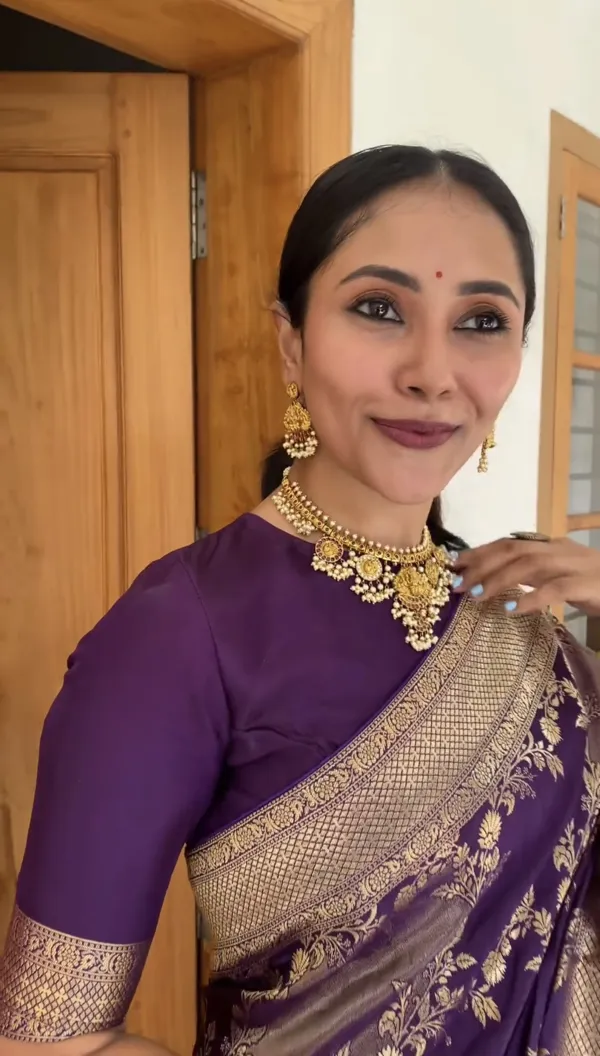


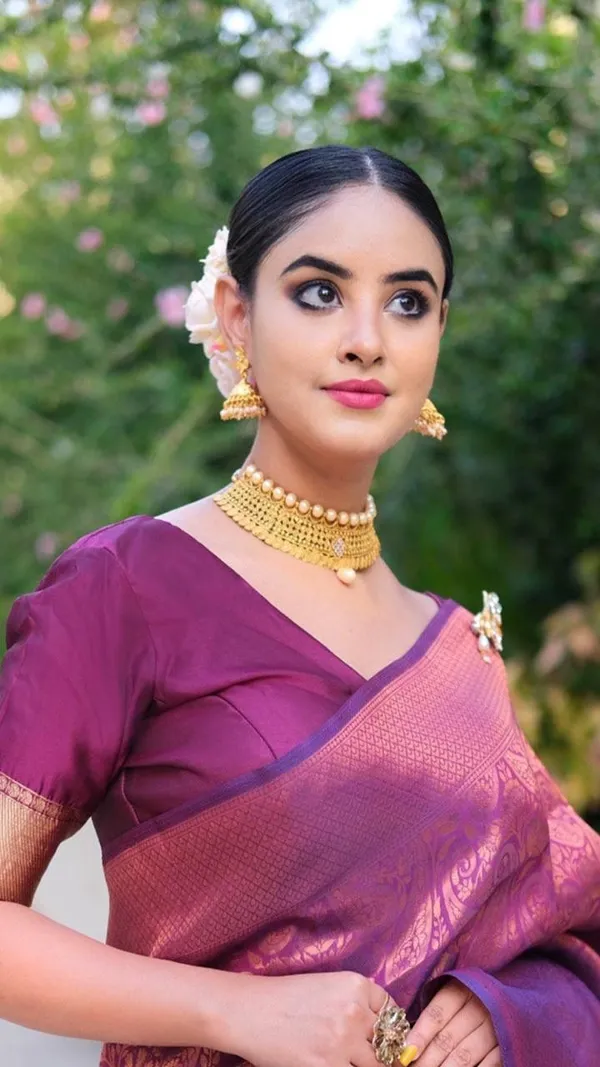
The Nivi drape is the most worn style across India and the easiest to learn. You need the saree, a fitted blouse, a petticoat and a few safety pins.
Before you start
- Wear the petticoat tied firmly at the waist and the blouse.
- Wear your footwear: the saree length depends on the heel height.
- Keep 3 to 4 safety pins ready.
Step by step
- Tuck the plain end of the saree into the petticoat at the right of the navel and wrap it once around the waist.
- Make sure the lower edge just touches the floor.
- Make 5 to 7 even pleats of about five inches each from the remaining fabric.
- Hold the pleats together, check they fall straight, and tuck them in just right of the navel, facing left.
- Take the rest of the saree around your back once more.
- Bring it up across the front and over the left shoulder; this is the pallu.
- Pleat the pallu neatly or leave it open, then pin it to the blouse at the shoulder.
- Adjust the length of the pallu so it falls to about the back of the knee.
Tips for a neat drape
- Soft silks hold pleats best when you run your fingers firmly down each pleat.
- One pin at the pleats and one at the shoulder is usually enough.
- Pre-pleat the pallu the night before for weddings and keep it pinned.
AAYNA tip
Soft Banarasi silk is much easier to drape than heavy silk, which is why it is a good choice if you are new to sarees.
Questions
How long is a saree?+
Our sarees are 5.5 metres, which is the standard length for the Nivi drape, plus a 0.8 metre blouse piece.
How many pleats should a saree have?+
Usually 5 to 7 pleats of about five inches each; slimmer frames may need fewer.